Showing posts with label local production. Show all posts

Sunday, September 04, 2011

Archival Production Report: Flap Wallet

Editor's Note: Nicholas Hollows, of Hollows Leather, is the craftsman behind our new Archival Flap Wallet. We asked him to document his production process in words and photographs. Here's what he had to say:

The Archival Flap Wallets are truly handmade pieces. The leather is cut by hand, shaped by hand, punched and stitched by hand. The hardware is set with a hammer, and the edges are hand-burnished with beeswax. The Chromexcel leather from Horween is incredibly supple and lends the final product a satisfying, book-like quality that feels great to hold. I'm proud of this work, and happy to share it.


Tuesday, November 16, 2010

Field Bag Round-Up


As I type, our sewing contractors are working on our first run of Archival Clothing Field Bags. Just like last time, we'll preface the introduction of a new product with a round-up of existing bags.


We've always loved Brady Bags, and this small trout bag has served Lesli faithfully for years. We like the heavy laminated duck, the fine quality webbing, and the convenient pocketing. The side-mounted shoulder strap also ensures a comfortable, close carry.


We really are Filson devotees, but we've found their Field Bag series to be challenging. This example has been used heavily by the Archival family for 15 years. Though it's built like a truck from top notch materials, we've found a few drawbacks. Abundant use of heavy twill, bridle leather and brass mean that the bag is heavy and bulky, even when unpacked. We prefer webbing shoulder straps to leather, as web is softer and more comfortable (and negates the need for a separate strap pad). Attaching the straps on the back panel means that the bag tends to flop downwards rather than hug the user's back. And a panel of extra fabric around the bag's opening keeps rain out, but also makes it harder to load and unload your gear.


One of our favorite bags, this Hunting World Safari Today is comfortable and convenient (there are two pockets on the inside). Of course, it's no longer available, and it doesn't fit laptops or much more than a half-day's worth of gear.


Though we love the hand-knotted fishing net on this old Chapman game bag, we had to admit that its utility is limited in daily use, as fingers get caught and small objects vanish instantly. We'll keep this one around for hunting squirrels, but we left the net off of our own Field Bag.


So surrounded by examples, both material and visual, we set off to design a workhorse shoulder bag that would equally serve an urban professional or a dedicated fisherman. Our requirements:

- Unquestionably durable construction
- A strap configuration that provides for a comfortable carry
- Useful pocketing while keeping the layout as minimal as possible
- Plenty of room for laptops
- Protection from the elements
- No features or finish that compromise function or unduly raise price (i.e. abundant leather trim)
- As with all of our products, domestic materials and manufacture to the best of our ability.

Results to be announced soon!


Wednesday, October 20, 2010

Archival Progress Report

Shawl collar cardigans (late November delivery)

Archival Clothing web belt with Horween leather tip (next week)

Steele Canvas Basket tote w/revised stencil (next week)

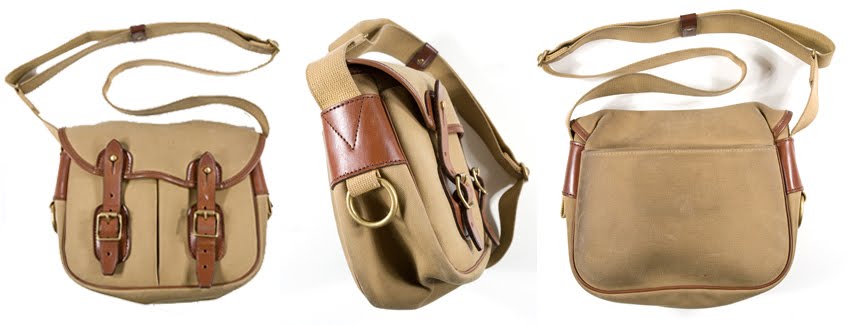
Archival Field Bag (coming soon)

On Thursday, we're heading out to NYC to see Tom and visit shops in Manhattan and Brooklyn. Tom and I will set aside time to review notes on the waxed jacket sample I just picked up from our sewer in Portland. Here are a few more Archival Clothing projects that will be making their debut in the coming weeks and months.

Next week, we'll have a restock of Archival Clothing web belts. For this production run, we've die cut a lightweight Horween hide for the belt tip. The belt will combine three of our favorite archival materials: Horween leather, mil spec cotton webbing and solid brass hardware.

I just received the first sample of our pure new worsted wool, shawl collar cardigan. Centralia Knitting Mills should deliver our full shipment by mid to late November. Look for the sweater in four colorways: multi-weave gray, cardinal red, navy and light gray. We've sized the sweaters for everyone from petite women to semi-sizeable gents. I'll be sporting my sample during shop visits this weekend.

Terry is busy sewing up new runs of our Archival Clothing Rucksacks and Flap Musettes in all colorways. He will also be working on our first small production run of Archival Clothing Field Bags. I'll file a separate report on this project closer to the release date.

In the next two weeks, we will be taking delivery of more Steele Canvas Basket totes with a stencil based on a vintage company pattern. Our custom janitor's tote will probably be available by mid-November.

We're waiting to see the first samples of our discharge printed, US made, all cotton kerchief. Progress report on this project to be filed shortly.

Check back in the next few weeks for more product pix and updates.

And look for an Archival NYC field trip report next week.

Friday, January 08, 2010

Archival Woolens

by Erin O'Meara


When people think of wool, images of sweaters, socks and toques come to mind. But wool isn’t just for clothing. Here are a few of my favorite woolen items.

Wool filled pillows for your bed

One of my grade school teachers told us to invest in satin sheets since we spend so much of our lives sleeping. That’s why I have a wool-filled pillow. Virgin wool is a great filler for pillows since the lanolin provides a natural deterrent to dust mites. It will also shape to your head better than synthetic fillers.

You could purchase a ready-made wool pillow or make your own by procuring a woolen batt from somewhere like Beaverslide Dry Goods – an amazing ranch in Montana that makes beautiful yarn from their own flock.

Milled Blankets

Domestically milled wool blankets are another favorite woolen good that’s a wonderful addition to any home. MacAusland's Woolen Mills (actually in Canada) is one of my favorite sources for milled wool blankets. I visited them last Spring. Here are some images from my tour:

Mill and store front on Prince Edward Island

This is the start of the processing for MacAusland blankets


One of their looms

Prepping the wool for the loom

Washed wool ready for spinning

Some finished products--they do a special plaid each year with different colorways

Other recommended sources for milled wool blankets include Amana Woolen Mills (since 1857!), Faribault, Bemidji Woolen Mills and of course, home state favorite, Pendleton (we like the National Park blanket series).

Sheepskins from a real farm

We’re not talking about a mass-produced product from Ikea or Costco, but rather, a real sheepskin from a working farm. There are resources on the web to help you locate a sheep farm in your region. In Oregon, contact Oregon Wool. Tanneries that handle small-scale processing are becoming scarce, so support your local shepherd or shepherdess by buying a sheepskin for a chair or couch in your home. I have a Wensleydale sheepskin from Dayspring Farm. Not all sheepskins are white - the variety of colors and curls of different types of sheep means that you can get one that suits your style. If you've never touched the real thing, you're in for a treat.