Showing posts with label guest baggage. Show all posts

Tuesday, March 13, 2012

Guest Post: DIY Vintage French Skiwear

Andrea Cesari of Unsung Sewing Patterns guest posts on her most recent find: men’s and women’s anoraks and ski pants patterns from France.

Collecting vintage home sewing patterns that are designed primarily for function rather than fashion takes me down some interesting paths. In twelve years of collecting I’ve managed to acquire what may be the oldest surviving pattern for men’s work wear; ladies’ “sack” aprons across several decades; men’s outing shirts with button-on sleeves from the 1910s and ‘20s, 1920s gymnasium suits, WWII era women’s utility clothing designed by the U.S. Department of Agriculture, and just recently, 1950’s French ski wear.

Late in 2011 a large lot of French home sewing patterns started showing up on eBay. The patterns, which dated from the late 1930s through the early 1960s, were mostly for women’s clothing with typically soigne French styling. But tucked in amongst the listings for blouses and skirts and car coats were two patterns for men’s and women’s ski wear. Sans doubt, these needed a home in my collection!

Outerwear patterns represent a very small portion of the pattern companies’ catalogs and of that tiny sliver, patterns for clothes for winter sports are even less common - usually patterns for skating outfits for girls and women and snow suits for children.

The patterns for these men’s and women’s anoraks and ski pants are quite unusual. The patterns are undated, but the illustration style points to the 1950’s, and at a guess, I’d say the first half of the decade. The first winter Olympics after the war was held in St. Moritz, Switzerland in 1948, and Frenchman Henri Oreiller took home gold and bronze medals in alpine skiing.


Henri Oreiller of France winning the downhill ski race in the 1948 Winter Olympics, St. Moritz, Switzerland.

A combination of a recovering post-war economy and national pride in their French Olympian may have led to increased interest in skiing and inspired the designers at Patron Modelè to produce these designs in the early 1950s.

Because no separate instruction sheets were provided for these patterns, careful examination of the limited instructions on the envelope is required in order to understand the construction. Let’s look at the ladies COSTUME SPORT first.


The full-cut pull-over anorak features an attached, gathered hood (capuchin fronce,) drawn in with an elastic around the face. The anorak is gathered in at the waist (taille fronces) with a drawstring. This nipping in of the waist assures that anorak won’t interfere with arm movement. Two small pockets with flaps (poche et rabat) are applied at the bottom the plastron front opening.
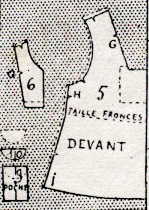


The pleated-waist trousers are cut full through hips and thighs for good mobility and are pegged at the ankles with a series of darts in both the front and back before being sewn onto narrow bands. Good-sized pockets in the trousers provide a place to stash mittens.
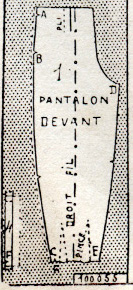


Both garments would probably have been made from woolen materials, although if I had the money, I’d be very tempted to make the anorak out of heavy, matte finish silk twill.

The gentleman’s style is very similar. The anorak includes design features you’d find in any good men’s jacket pattern, including two-piece sleeves and a vented back. A center front zip (fermeture) opening as well as zipped chest pockets are appropriate for sportswear, along with good-sized patch pockets at the lower edge. The sleeves are gathered into wrist bands.


Again, the waist of the anorak is drawn in with an elastic (possibly one of the most wonderfully unpronounceable french words ever: caoutchouc.) The removable hood buttons to the anorak.
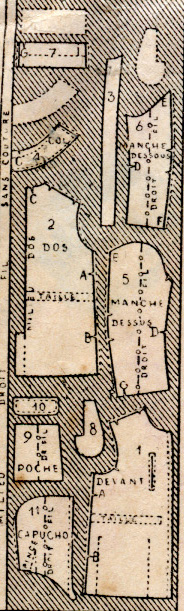


The fly-fronted trousers are pegged by means of darts (pinces) both front and back. Darts at the front waist remove some of the fullness from the seat and there are good-sized pockets. I had originally thought that the crotch was gusseted for reinforcement but on closer examination of the layout, it appears that the trousers are cut so full through the hips that they wouldn’t lay out on the fabric and had to be pieced.


The instructions and illustrations on the envelopes provide a remarkable amount of information, but success in making up these patterns would depend on a pretty high degree of skill. Most seams would need to be hand-basted before machining, and the seams would then need to be clean finished for both durability and comfort.

Both patterns are unprinted and do not appear to have been used, although the envelopes had been unsealed.

-- Andrea Cesari,
Chief Cook and Bottle Washer at www.unsungsewingpatterns.net

Thursday, February 02, 2012

Guest Post: Archival Field Bag Review


Thanks to longtime friend and photographer Rick G. for this review. Rick has an early Field Bag that, we wager, has seen some of the hardest use of any Archival baggage!

As the waterfowl season draws to a close here in Washington State, I thought I would submit a review of the Archival Clothing Field Bag. I have been using this bag all season as a catchall blind bag/jump shooting bag.
It has been a great hunting companion--thorn proof, waterproof, roomy, and quiet. It has seen 28 days in the field this year, and has seen its fair share of accidental dunkings, mud, a whole lot of rain, and more mud. I am pleased to say that the contents of my bag have stayed uniformly dry and clean. An added bonus, the brass ring on the side is a perfect place to clip a game strap.
I initially thought that this bag would be an urban laptop and sketchbook hauler (since it does serve that purpose well), but I soon pressed it into service as a working field bag. It nicely holds all of the necessities for a day afield: a box or two of shot shells, binoculars, extra layers, water bottle, etc…
Recently, an unfortunate, hip high, encounter with a drainage ditch left my bag and I covered with unspeakably smelly mud. After letting it dry out, a stiff brushing and another rainstorm was all it needed to get it cleaned up and looking good.
Can’t ask much more than that.

Typical contents


Detail View

Tuesday, January 31, 2012

Archival Footwear - Sidi Touring Shoes

AC friend and Rivendell General Manager, John Bennett, sent me photos of his unworn Sidi touring shoes. Unlike modern "carbon" models w/velcro strap adjustments, John's Sidis come with an old fashioned lacing system and walkable soles. Though these Sidis come from the past, several of my randonneuring friends wore them during this year's edition of Paris-Brest-Paris. I think they're stunning enough to wear with cords knickers and a wool pullover to work.


Thursday, November 17, 2011

Guest Report: Vintage Filson Cruiser Jacket

From the archives: Filson Forestry Cloth Cruiser

Filson fabric options in 1914

Mid century price hike

The modern Filson Mac

Editor's note: A month ago, Chris Adamiak, Damn-Yak Dry Goods proprietor, emailed me about a vintage Filson cruiser he spotted on Etsy. He asked for my help in identifying the fabric which is lighter weight than the 24 oz. melton wool used for current model Filson cruisers. I forwarded along some Filson catalog scans speculating that the fabric in question was a discontinued worsted wool serge. Chris purchased the Cruiser and, at my request, wrote up a review for Archival.

The Filson Cruiser in question

In Canada, Filson doesn't have the availability as it does in the States. The distributors are few and far, and when we order online we face massive shipping, duty, and custom fees (due to the weight of Filson's heavy fabric). It makes me so upset reading tales in forums of people finding Tin Cloth Cruisers in Thrift stores for $5. Finding Filson anything, in any store here is a miracle and being 6'5" makes the search even harder for vintage items.


I have spent countless hours scouring Etsy, Ebay, and many other vintage clothing shops online for decently priced Filson that I can actually wear. Two weeks ago I stumbled upon this late 50's to mid 60's green wool cruiser for $50. The measurements seem to match my Pointer brand chore coat I wear daily. So without hesitation I scooped it up. After my purchase I contacted Lesli, in regard to its fabric, because in the picture on the listing it seemed very light. With a quick reply she sent me a link to a old catalog page (see below) suggesting that it might be worsted serge. However, on that same catalog picture there is no mention of a green worsted serge, only grey, brown, or beige. Then I saw the display tag from AC's Flickr page for a early forestry cloth cruiser. It states that forestry cloth is a green Worsted serge. This made me even more excited. Could it be a rarer piece in my size?


Last week the Etsy Cruiser arrived and taking it out of the package, I was amazed at how "new" it was. It looked like it was only worn maybe one season. I was also surprised at the weight of the jacket. It was not light and flimsy but quite heavy and tough. The tight, diagonal wool twill does not stretch, and has no problem blocking all the light when held up to a bulb. The fit is true Filson. I wear a 44 suit and this is bang on. Although looking at the label there is no size tag, so I cannot be sure of its exact size. The green color is still very pure, with only tiny specks of fading. Also this past week here in Toronto it has been about 9*C (48*F) in the morning and I was surprised at how warm this cruiser is. Along with being very warm , the cruiser still provides plenty of movement and doesn't catch and stay up on my back when reaching above my head. I have never worn a Filson Mackinaw, but I have heard that they are quite heavy and extremely warm. I have a early Woolrich Buffalo plaid mackinaw and you can forget being indoors for any length of time with a coat like that on! That's where the Cruiser coat fits in perfectly. The fabric is thin enough to move from outdoors to indoors, tough enough to trek through thickets and brush, tight enough to ward off light showers and snow, and roomy enough for layering options underneath.


I am not exactly sure if it the jacket is made in forestry cloth or whipcord, as I have never held or seen either up close. But what I do know is that this cruiser is not a standard issue item. Why Filson eliminated this fabric as a standard cruiser option baffles me -- they still make shirts out of serge and pants out of whipcord. From what I have been told, they will still make whipcord cruisers in their custom shop for a greater price. Its a great seasonal transition coat, from Summer to Fall and Winter to Spring. This coat will definitely be a new daily driver for me from city to forest. And as much as I really like this coat, the search for these kind of pieces never ever really ends!

Evidence of worsted serge in the 1980s/90s

Sunday, September 04, 2011

Archival Production Report: Flap Wallet

Editor's Note: Nicholas Hollows, of Hollows Leather, is the craftsman behind our new Archival Flap Wallet. We asked him to document his production process in words and photographs. Here's what he had to say:

The Archival Flap Wallets are truly handmade pieces. The leather is cut by hand, shaped by hand, punched and stitched by hand. The hardware is set with a hammer, and the edges are hand-burnished with beeswax. The Chromexcel leather from Horween is incredibly supple and lends the final product a satisfying, book-like quality that feels great to hold. I'm proud of this work, and happy to share it.


Thursday, August 04, 2011

Guest Review: Chimala Chambray Shirt

by Tiffany Thornton


I've been brand-stalking Chimala for a while now (via Lark: Chimala was started in 2006 by a Japanese designer, and is named for an imaginary mountain in the Himalayas... The brand concept is new vintage casual with a touch of "good old days" feeling. The design inspirations and sources are mostly from the 1940's through to the 1970's daily wear. The universal design often seen in military work wear is given a modern twist.)

Slightly contrasting chest pockets

After mulling it over for some time (Chimala is very expensive; about $400 CD for a shirt gave me about a year's worth of pause) I decided to pick up a Chimala chambray work shirt from Lark. I pestered the kind folks at Lark for about a day and a half on sizing (I am small of frame, but have broad shoulders), and then made my purchase and hoped for the best. Despite being slightly uncomfortable with dropping that much on a single shirt, I have not regretted the purchase one bit.

Yellow stitched pencil slot

The chambray work shirt I picked up recently is apparently produced each season with different details each time. The details that sold me on this Spring '11 version were: the slightly contrasting chest pocket, the contrast blue button, and the yellow stitched "pencil slot" on the pocket. The material is a pale blue chambray that is light, but not flimsy, and thus far seems to breathe well. Perfect for wearing to work in the Spring and Fall. The color is versatile, and could go with just about anything; I prefer to pair it with some brown corduroy trousers for the time being. It is also something of a relief to me that the Chimala medium size fits about perfectly: most button downs always seem to fit awkwardly on me because short torso + broad shoulders = unaccounted for by most clothing manufacturers.


Each season the Chimala shirt is made with new distressing and detailing

In general, I'm very pleased with this shirt: it is well crafted, attractive, comfortable and versatile. The major downside is the prohibitively high cost, but if it's an issue that can be rectified, I certainly would recommend checking out Chimala if you're in the market for something new.