Showing posts with label uniforms. Show all posts

Tuesday, June 05, 2012

Archival Jockey Silks


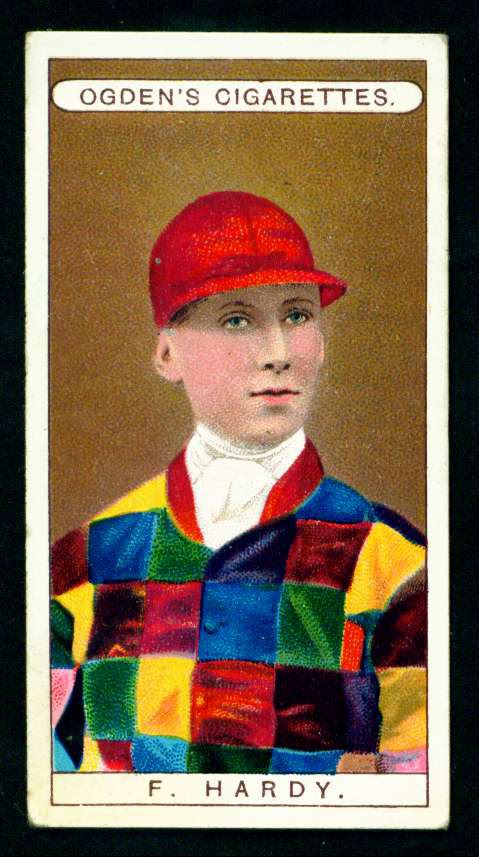
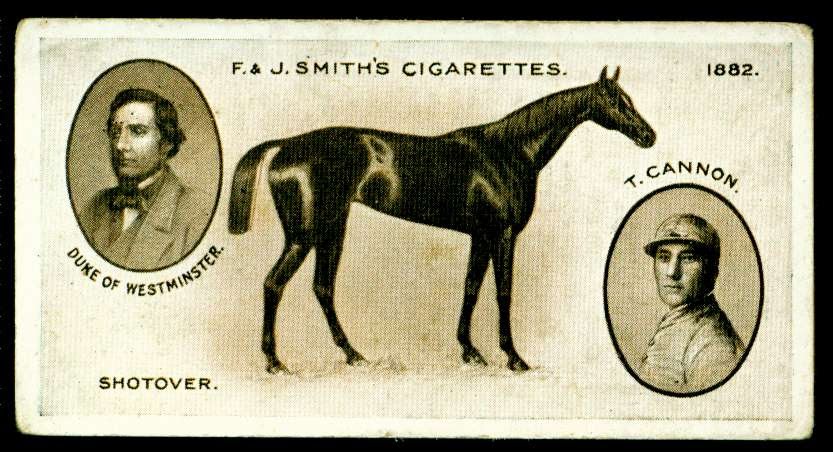
I have a deep fondness for jockey silks. Unlike most sporting garb, the basic jockey's uniform of jodphurs, cap and tunic has remained unchanged over time. Designed for legibility from a distance, the visual code of stripes, dots, hoops, sashes, crosses, chevrons and bold colors has a functional beauty that appeals to me in any media - from cigarette cards to a high definition broadcast of a triple crown race. If you squint, a snapshot of horses in the homestretch today doesn't look that different than an image from the past. What has changed, of course, is the addition of advertising on the trousers and the use of more closely fitting, synthetic fabrics. In honor of the upcoming Belmont Stakes I'm reprinting these cigarette cards featuring ad free British horse racing colors from the 1930s.




Tuesday, September 27, 2011

From the Archives: Rugby Ephemera

In honor of the World Cup, I'm reposting selections from Frederick Humbert's awesome collection of historical rugby print ephemera. Humbert's flickr catalog and blog, Rugby-Pioneers, include photographs, programs, cigarette cards, advertisements and even hand painted lantern slides of vintage rugby action. Even if you don't follow rugby as a sport, study the photographs as a guide to looking stylish in a sports uniform (blazers and wool knits in lieu of track jackets and sweats).


Friday, May 20, 2011

Archival Jackets: Mister Freedom Biribi


I'm always shopping for a jacket to complete my archival uniform. My preferred jacket possesses indoor-outdoor utility. It needs to be unlined w/open patch pockets and a high buttoning neck. Chore coats, forestry cloth cruisers and and engineer's jackets work OK from Fall through Winter. But in Spring/Summer, I want something made from a summerweight fabric like cotton poplin or linen. Last year, I experimented with Safari jackets but could not pull off the belted waist and epaulets (epaulets should just disappear for a decade).

This Spring, I'm testing a Mister Freedom Biribi linen jacket. Based on French military work garb, the Biribi is constructed of new old stock French linens and vintage hardware and trims. The Biribi is one of the few work jacket styles that are being marketed to both men and women; it comes in sizes down to a slim 34. If you are interested in the jacket, email the helpful folks at Mister Freedom to check on availability.

Here are some catch and release snaps.


Here is Jing's report on her striped Biribi jacket (via Hands on with X).

Wednesday, March 16, 2011

From the Archives: Women War Workers

"Chippers." Women war workers of Marinship Corp, 1942

The U.S. National Archives just released these terrific photos of female war workers from WW II. The images are part of NARA's Women in WW II series. Original captions are included below.

U.S. Army nurses, newly arrived, line the rail of their vessel as it pulls into port of Greenock, Scotland, in European Theater of Operations.

Secretaries, housewives, waitresses, women from all over central Florida are getting into vocational schools to learn war work. Typical are these in the Daytona Beach branch of the Volusia county vocational school., 04/1942

Women man America's machines in a west coast airplane factory, where the swing shift of drill press operators is composed almost entirely of women., 05/1942

Auxiliaries Ruth Wade and Lucille Mayo (left to right) further demonstrate their ability to service trucks as taught them during the processing period at Fort Des Moines and put into practice at Fort Huachuca, Arizona., 12/08/1942

With the grade and dexterity of a master dressmaker, this young woman fabricates "pup" tents for the expanding war army at the Langdon Tent & Awning Company., ca. 06/1941

Building assault boats for U.S. Marine Corps. by women workers., ca. 12/1941

Training in marksmanship helps girls at Roosevelt High School in Los Angeles, Calif., develop into responsible women. Part of Victory Corps activities there, rifle practice encourages girls to be accurate in handling firearms., 08/1942