Showing posts with label hats. Show all posts

Friday, September 28, 2012

Archival Mug Shots


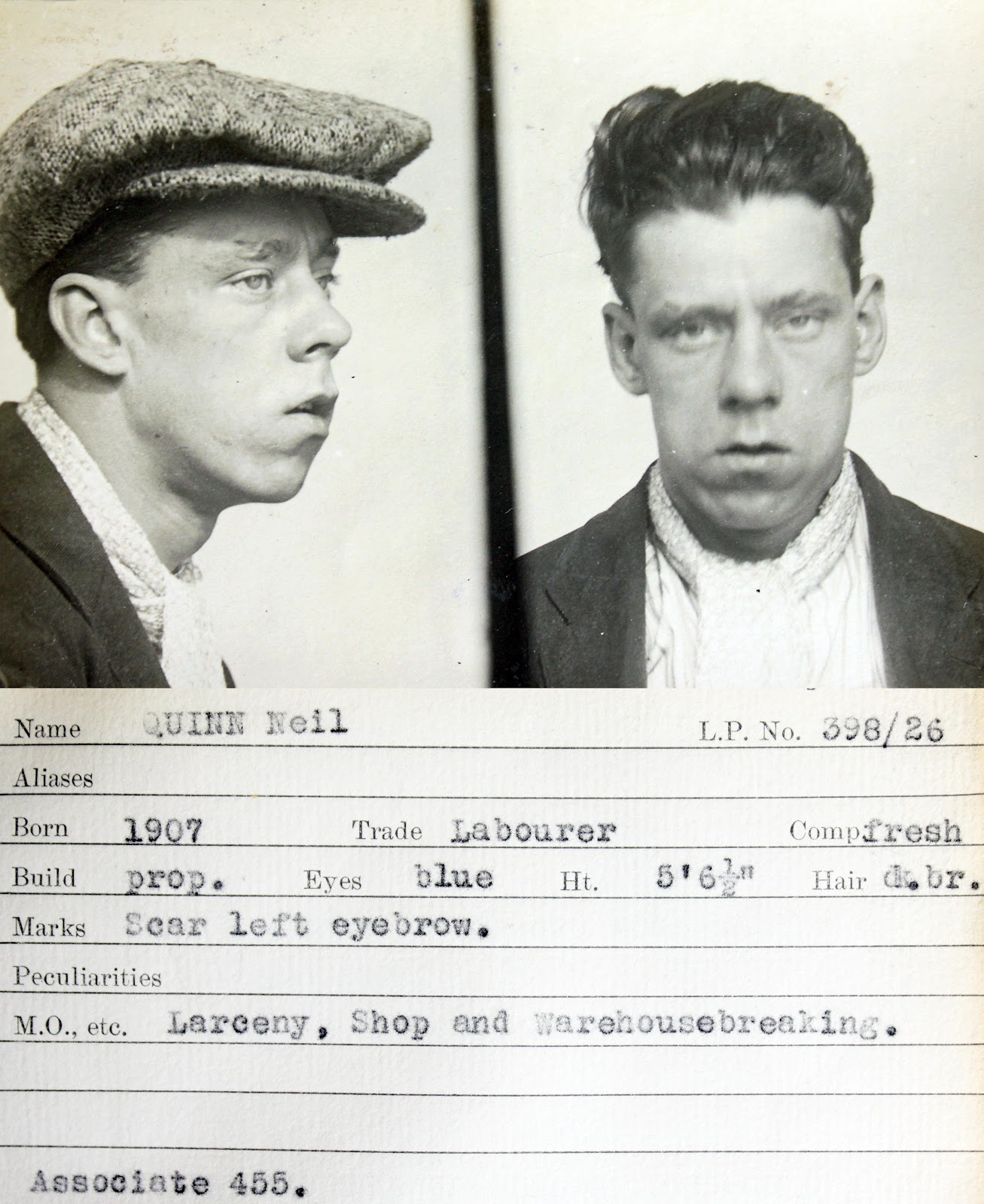
The Tyne and Wear Archives & Museum has just released a terrific set of mug shots from a 1930s.  According to the TWAM site, the photos come from an identification book originally sourced from a junk shop.  What I love about these photos are the split view poses struck by the disheveled yet handsomely dressed perps.  Adding a touch of high art, several of the secondary views are out of focus or feel gratuitous - like school retake photos showing us the perp's better half.  Out of context, the mug shots read like casting photos for Fritz Lang's M or the latest Engineered Garments lookbook.

Examine the cards closely and you'll see evidence of a downbeat, Raymond Chandleresque portrait of crime and criminal behavior in the 30s (one that feels oblique and victimless).  Targets include a depopulated sphere of clubs, warehouses, offices, and shops.  My favorite M.O. (revealing a full character portrait in a few phrases) can be found on the final mug shot for William Jones (DEAD):  "Shopbreaking.  Uses various method of entry. Works alone.  Plays violin outside public houses. Convicition in America for shooting a man."


Monday, October 11, 2010

Duckbill Review


Original Filson duckbill offerings

A duckbill cap was the first item I ever purchased from CC Filson. A decade ago, you could buy a Filson duckbill cap in tin cloth, shelter cloth, cotton poplin or wool. Filson even offered a short billed model (my personal favorite). The original duckbill version was fitted and came with a leather sweatband. Filson has dropped the wool and poplin models and switched over to a one size fits all model with a cotton sweatband.

I have a small collection of caps that I rotate through the seasons: poplin for summer, tin cloth for fall, wool for winter and shelter cloth cloth for spring. The duckbill cap makes for an ideal cycling cap. The long bill keeps the sun and rain out of your eyes and the low profile, four panel crowd closely hugs the head (making it possible to tuck the hat under a bike helmet).

I'm unclear on the origin of the duckbill style but there may be a military connection. A gent at the Pacific Aviation Museum in Honolulu once mistook mine for a WWII military reissue.

Unlike a baseball cap with a stiffened brim, the pliable, unstructured duckbill takes on an origami shape that makes it ideal for carrying in coat pocket or bag. Perfect for protection during a sudden squall.

A few sample duckbill caps from my archives:
Original Filson duckbill in tin cloth

Filson duckbill in cotton poplin

Filson short duckbill

Filson wool duckbill

Monday, August 23, 2010

Archival DIY: Reproofing Waxed Cotton

Martexin reproofing wax. Operating instructions on the can.

Archival Clothing endorses waxed cotton because it's a rugged, natural, water resistant fabric that requires only wax reproofing to maintain its finish. Waxed cotton users should know how to reprooof their jackets, hats, and bags. Both Filson and Barbour offer factory reproofing services but we recommend performing the work yourself (at least once). Reproofing waxed cotton is relatively easy and personalizes the care and maintenance of your garment. Even if you live in the desert, you should establish a reproofing schedule for your waxed cotton. Reproofing extends the life of waxed cotton and prevents it from developing the folds and wear lines that often lead to holes.

I do my reproofing in August so I can move the work outdoors.

Basic tools: wax (warmed), water, sponge, blow dryer (or heat gun). If you're using our 1.5 ounce tin, spoon some wax into a bowl and heat briefly in microwave. Some people recommend using Filson wax, say, with a Filson product, but I've switched between several brands of wax treatment (Filson, Barbour and Martinex) with the same results. I will concede that for a full reproofing job on a jacket, the larger tins of Barbour reproofing wax are easier to heat in a double boiler.

Dab off dirt with a moistened sponge. Do not use soaps or detergents.

Use clean sponge to spread warmed reproofing wax thinly on fabric. Short strokes work best.

Reheat surface of item with blow dryer to melt the wax into the fabric.

Reapply wax until it evenly coats the bag.

Restored to original factory finish

I still have wax left so I'm reproofing a couple of my Filson duckbill caps

You'll be moving back and forth between wax applications and the blow dryer


Don't expect the wax to glaze evenly over fabric. You'll need to work it into the surface.

There! You've shopped from yourself. These rewaxed hats are better than new. Let the sun help w/the final reproofing. Use a blow dryer again if you find any remaining, unmelted spots of wax. If you've overdone it, fear not, daily use and rain will wear down the excess wax.

Wednesday, March 17, 2010

Archival Lament: Cooperstown Ball Cap Co.


Cooperstown Ball Cap Co. print catalog covers (1994, 1999)

Sometimes I get so fixated on the past that I forget to mail order from the present. A quick web check on one of my favorite contemporary brands, Cooperstown Ball Cap Co., produced this depressing news:

Regrettably, after twenty-three years of making fine historic replica ball caps, Cooperstown Ball Cap Company has discontinued operations. Commercial, financial and legal difficulties; and the complexity of sewing one-of-a-kind caps in the U.S, make this decision inevitable. We thank all our customers for whom, over the years, we have been pleased to make a true vintage ball cap.

For reference, Cooperstown Ball Cap Co. manufactured custom caps for historical teams and individuals. One could order a cap in any historical style or in any combination of styles, logos or colors. The illustrated Cooperstown catalogs featured examples of nearly every known historical baseball team including company teams, military teams and even a hat from the Eastern Washington Hospital for the Mentally Insane. All caps were handmade from 13 oz. athletic flannel, horsehide leather bands and highest grade peak stiffeners. Whenever possible, caps were sewn on original machines in Cooperstown, NY.


Historical styles that influenced the modern baseball cap

For reference, I'm reprinting a few pages from two of my 1990s era catalogs. At some point, the company moved to an online ordering format. But I always loved the colorful illustrations, hand scripted captions, arcane keycode system and personal notations of these early catalogs.

Until the 1940s, caps lacked stiffening crowns. Most of the cap styles in the Cooperstown catalog were designed to be worn close to the head (a look I prefer to the current trend towards fully stiffened, high crown caps).

Choose your Brooklyn style cap: standard, pinstripe, peak band, cap band, 3 color braid or soutache?


Small sampling of minor league caps

Shopping from A League of Their Own

Each year, Cooperstown reissued newly discovered styles from lesser known or non-professional teams. These were special edition options from 1994.

A few special edition and "fictional" team caps including one for the New York Knights

International models (I always wanted a Yomoyuri Giants cap)

Regretting that I never mailed out my order for one of the cricket caps (see 1999 cover)

New discoveries for 1999

Caps could be ordered in any combination of colors or historical styles

Custom sizing options (I always requested a shallow crown w/a short cut)